
Two days on the floor at Affiliate Summit East left us with more open questions than closed ones, and that is a good sign. Affiliate and influencer marketing is not settling into a new normal. It is mid-shift, and three sessions in particular mapped the terrain: where AI is already changing how people shop, where retail media and affiliate are colliding, and how incrementality is a mix of approaches, insights, and good math.
AI Is Already Reshaping Shopping, Most Brands Have Not Caught Up
Data and framing from Max Willens, Senior Analyst, EMARKETERSession: “Navigating the AI Content Economy: Three Strategies and the Trade-offs Behind Them” | Monday, July 27, 10:30 AM
One in three consumers now turn to AI for shopping research at least once a month, and that number is climbing fast. They are using it to research specific products, compare prices, get recommendations, and figure out where to actually buy. What matters for our world is that LLMs are increasingly citing community and publisher content when they make those recommendations, and a lot of it traces back to affiliate and influencer sources.
Brands know something is happening. They just have not built the muscle to respond to it yet.
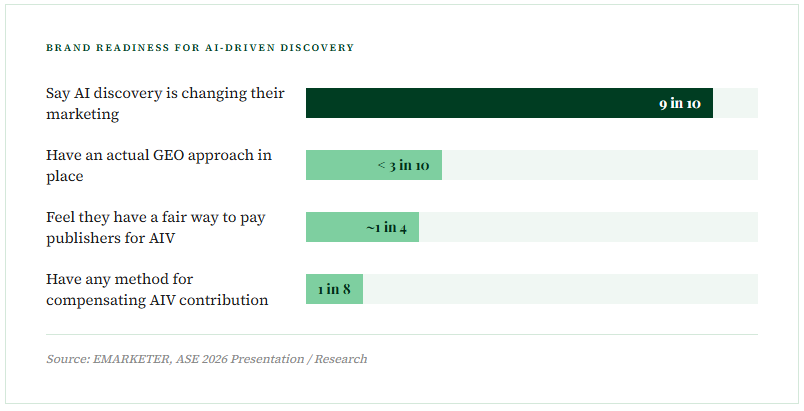
Worth being precise about two terms that get used interchangeably and should not be. GEO is the tactic: optimizing content so LLMs actually cite it. AIV, AI visibility, is the outcome you measure: how often your brand or a publisher’s link shows up in AI-generated answers. Brands are ahead on believing GEO matters and behind on measuring AIV, let alone paying for it.
Willens has made a version of this point elsewhere too. In remarks reported from a separate EMARKETER discussion on AI discovery, he put it plainly: affiliate content sites routinely rank among the most cited domains in LLM replies, and creator content on trusted platforms can move a brand’s AI visibility fast.
Our View
The practical ramification is a partner mix audit, not just a content calendar update. Programs built mostly on coupon and sub-affiliate networks have very little to offer an LLM looking for a citable answer, since discount codes do not explain which product to buy or why.
The publishers worth prioritizing now are the ones who actually write about what your audience is searching, comparison content, category buying guides, and reviews from sources with real standing in the space. That means evaluating the current mix honestly: how much of it is coupon and incentive traffic versus genuine editorial authority, and where the gap sits relative to competitors already investing in that second group.
It also means building GEO requirements directly into affiliate content briefs, structured comparisons, clear specs, recent publish dates, rather than treating optimization as something to retrofit after a piece is already live.
Affiliate content sites routinely rank among the most cited domains in LLM replies.
Max Willens, Principal Analyst, EMARKETERRetail Media and Affiliate Are Converging
Data and framing from Amy Sheridan, Senior DSP Sales Specialist, Walmart Connect, and Melissa Salas, Sr. Director of Marketing, Campaigns & Partnerships, ShopSimon.comSession: “Retail Media and Affiliate: Turning the Rise of Retail Media Into a Programme Advantage” | Monday, July 27, 4:20 PM
Retail media budgets are growing fast, and affiliate programs are facing broader questions about where they fit alongside that growth. The pitch that landed hardest in the room: retail media brings first-party data, affiliate brings the independent voice of a creator. Together they cover ground that neither one covers alone.
A wave of new services is emerging just to help brands manage creators through retail media networks. Which layer wins that fight is worth watching over the next year, since it will likely decide who owns the relationship with the creator going forward, the retail media network or the affiliate program manager.
Our View
It should be the affiliate and partner manager, not the retail media network. Retail media networks are built to sell placement and confirm the sale after the fact. They are not built to source a creator, negotiate a relationship, brief content that ranks and gets cited, or manage the ongoing partnership as it grows.
That is affiliate management’s core competency, and it is exactly the skill set that AI-driven discovery is rewarding right now. A retail media network can validate that a creator’s content converted. It cannot originate the relationship or the content in the first place.
Brands that let the retail media layer absorb creator management are handing over the one piece of the funnel that actually requires an independent, trusted voice, which is the whole reason it works with LLMs to begin with.
First-Party Purchase Data
Retail media networks sit on data that validates whether a sale actually happened. That is the missing half of the AI-discovery picture, since someone has to confirm the AI-influenced browsing turned into revenue.
The Independent Voice
Affiliate and creator content is what feeds the LLM’s answer in the first place. It is the input side of the discovery loop that retail media data alone cannot generate.
Incrementality Still Comes Down to Three Tools
Framing from Madan Bharadwaj, Founder & CEO, M2Every deep dive on measuring true affiliate impact came back to the same three methods: marketing mix modeling, holdout testing, and geo-matched market testing. Two of the three got real airtime, and the distinction between them matters more than the conference badge copy usually lets on.
| Method | Level of Measurement | Where It Works | Where It Breaks Down |
|---|---|---|---|
| Holdout testing | Individual user | Cleanest causal read available, isolates the channel at the person level | Rare in practice. You cannot ask an independent publisher or a creator’s own feed to selectively hide your product from a control group the way you can pause a paid social impression buy |
| Geo-matched market testing | Regional market | Strong fit for prospecting tactics, upper and mid-funnel content publishers and creators whose placements can be turned off or targeted by region | Weak fit for bottom-funnel channels like national deal and coupon sites or browser extensions, where users and codes travel across market boundaries regardless of geography |
| Marketing mix modeling | Aggregate / channel | Useful top-down check across the full media mix | Least granular of the three, more directional than diagnostic at the individual publisher level |
The real reason user-level holdouts stay rare in this channel is not a tracking problem, it is a delivery and incentive problem. Affiliate exposure happens on someone else’s property. Geo testing sidesteps that by working at the market level instead, which is exactly why it holds up for prospecting content and falls apart for bottom-funnel placements where geography stops meaning anything.
Where This Points for Programs Like Ours
The practical question coming out of ASE is not whether AI is changing discovery. Everyone in the room agreed on that. The real question is how you build an affiliate program that actually supports GEO and drives AIV, rather than hoping your existing publisher mix happens to get picked up by LLMs.
Prioritize Citation-Worthy Publisher Types
Comparison content, buying guides, and reviews from sources with real category authority are what LLMs already cite most. That is where the citation data points, so that is where partner development should concentrate first.
Bake GEO Into the Content Brief
Structured comparisons, clear product specs, and recent publish dates are GEO-friendly requirements. Treat them as part of the affiliate content brief from the start, not an afterthought layered on after a piece already exists.
Start Tracking AIV Now, Even Informally
Compensation standards for AI visibility have not caught up to the industry yet. Programs that start tracking AIV alongside attributed sales today will have a baseline in place before those standards ever settle.
The retail media connection is the more interesting piece long term. Retail media networks hold the first-party data that can confirm whether AI-driven discovery is actually converting, while affiliate and creator content is what feeds the LLM’s answer in the first place. A program that pairs its affiliate GEO strategy with retail media measurement gets a closed loop most brands do not have yet: independent content driving the citation, first-party data confirming the sale. That combination is likely where the next real edge shows up, well before the compensation standards this industry is still waiting on ever get settled.
Not Sure Where Your Program Stands on Any of This?
Book a strategy call with Reid Colson to walk through your current partner mix, where GEO fits into your content briefs, and whether your program is set up to own the creator relationship or hand it away.
Book a Strategy Call
Leave a Reply