

Most affiliate programs look healthy until they don’t. Revenue is coming in, the reporting looks fine, and nobody asks hard questions. Then Google makes a change, a top publisher goes quiet, or attribution starts dropping, and the program that looked stable turns out to have been built on a single fragile foundation.
We have seen this pattern more times than we care to count. A brand’s affiliate program is generating real revenue, but 70 percent of it traces back to SEO-dependent publishers who rank for product review keywords in Google. Those publishers are now watching their traffic collapse. And when their traffic goes, the brand’s affiliate revenue follows.
The problem is not the affiliate channel. The problem is the partner mix. And in 2026, with Google actively dismantling the traffic model that SEO publishers depend on, an over-indexed partner mix is not just a strategic risk. It is a near-term revenue problem.
This piece gives you a framework to assess exactly where your program stands, a scoring tool you can run right now, and a clear set of actions based on what you find.
Why Partner Mix Is the Right Metric
Most affiliate program audits focus on the wrong things. Tracking accuracy, commission rates, terms and conditions, FTC compliance. These matter, but they are table stakes. Fixing them does not tell you whether your program is structurally positioned to grow or structurally positioned to decline.
Partner mix does. It tells you how concentrated your revenue is, which traffic sources your partners depend on, and how much of your program performance is correlated with factors outside your control, specifically Google’s ongoing decision to give its own products the traffic that used to go to publishers.
The core question the audit answers is simple: if Google’s algorithm changes tomorrow, what percentage of your affiliate revenue is at risk?
For most programs we have reviewed, the honest answer is somewhere between uncomfortable and alarming. The brands that have done the work to diversify their partner mix away from SEO dependency are in a fundamentally different position than those that have not. The gap between them is widening every month.
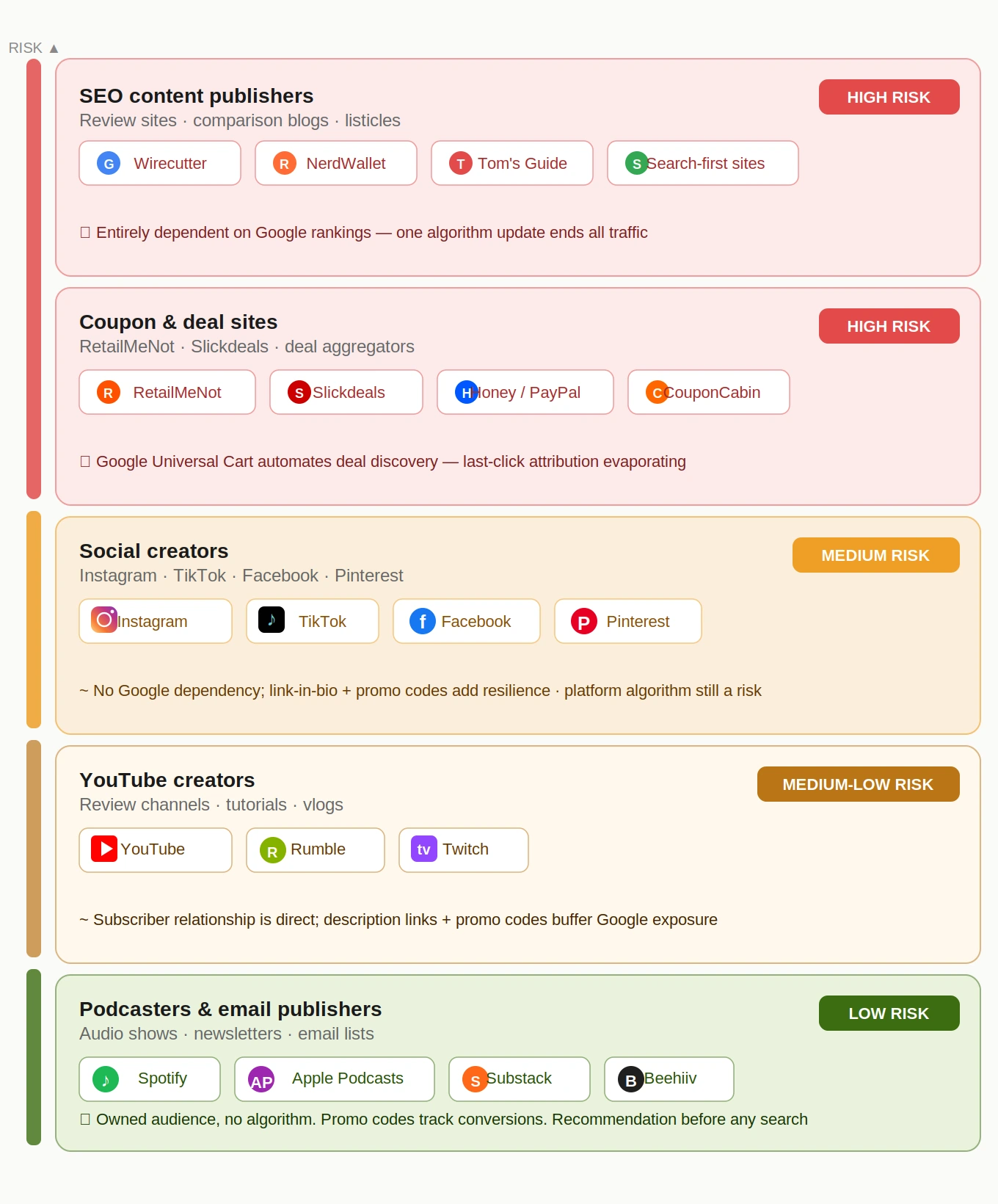
The Five Partner Categories and Their Risk Profile
Not all affiliate partners carry the same structural risk in the current environment. Here is how the five main categories break down, and what drives the risk assessment for each.
| Partner type | Traffic source | Attribution resilience | Risk in 2026 |
|---|---|---|---|
| SEO content publishers Review sites, comparison blogs, listicles |
Google organic search | Low. Depends entirely on click-through from Google rankings. | HIGH |
| Coupon and deal sites RetailMeNot, Slickdeals, deal aggregators |
Google search + direct/bookmark | Very low. Google Universal Cart automates deal discovery and undercuts last-click attribution. | HIGH |
| Social creators Instagram, TikTok, Facebook |
Platform-native, no Google dependency | Medium. Link-in-bio works. Short consideration cycles help. Promo codes add resilience. | MEDIUM |
| YouTube creators Review channels, tutorial content, vlogs |
YouTube subscribers + some Google search | Medium-high. Subscriber relationship is direct. Description links still work. Codes as backup. | MEDIUM-LOW |
| Podcasters and email publishers Audio shows, newsletters, email lists |
Owned audience. No algorithm involved. | Highest. Recommendation happens before any search. Promo codes track conversions reliably. | LOW |
The pattern is straightforward: the more a partner’s traffic depends on Google sending visitors to their content, the more exposure that partner carries. Podcasters and email publishers are structurally immune to what Google is doing because their audience relationship does not route through Google at any point. SEO publishers have no such protection.
The question is not whether your top affiliates are good partners. The question is whether the traffic source they depend on will exist in the same form two years from now.
Revit Digital · Affiliate Program AnalysisThe Partner Mix Scorecard
Run this against your current program. You will need your affiliate platform reporting open alongside it. Pull the last 90 days of commission data by partner, sorted by revenue contribution. The whole exercise takes about 20 minutes.
For each question, select the answer that best describes your program and note the points. Add them up at the end.
Partner Mix Scorecard
Six questions. 20 minutes. A clear picture of where you stand.
What percentage of your affiliate revenue comes from SEO content publishers? (Review sites, “best of” articles, comparison content that ranks on Google.)
Under 20% → 3 points | 20-40% → 2 points | 40-60% → 1 point | Over 60% → 0 points
What percentage of your affiliate revenue comes from coupon, deal, or cashback sites? (RetailMeNot, Honey, Capital One Shopping, Slickdeals, and similar.)
Under 10% → 3 points | 10-25% → 2 points | 25-40% → 1 point | Over 40% → 0 points
What percentage of your affiliate revenue comes from owned-audience partners? (Podcasters, email newsletter publishers, YouTube creators with strong subscriber bases. Not counting social creators primarily reliant on algorithmic reach.)
Over 30% → 3 points | 15-30% → 2 points | 5-15% → 1 point | Under 5% → 0 points
How concentrated is your revenue in your top three partners?
Top 3 under 30% of total revenue → 3 points | 30-50% → 2 points | 50-70% → 1 point | Over 70% → 0 points
How are your creator partnerships tracked?
Tracking links plus unique promo codes for every partner → 3 points | Tracking links plus codes for top partners only → 2 points | Tracking links only, no codes → 1 point | Inconsistent or unclear → 0 points
When did you last actively recruit new partners specifically outside the SEO content category?
Active recruitment program running now → 3 points | Recruited new non-SEO partners in the last 6 months → 2 points | Recruited some in the last 12 months → 1 point | Not a current focus → 0 points
How to Read Your Score
Your program has meaningful diversification away from SEO-dependent partners. The structural risk from Google’s changes is lower than average. The focus now is compounding: keep recruiting into owned-audience categories, ensure every partner has both a tracking link and a promo code, and stay ahead of attribution model conversations with your team.
You have meaningful exposure to SEO-dependent or coupon partners, or your owned-audience mix is thinner than it should be. The program is not in crisis, but the window to rebalance proactively is open right now. Waiting until you see the revenue impact makes the problem harder and more expensive to fix. Start with a recruitment push into podcasters and email publishers in your category.
Your program has concentrated dependency on partners and traffic sources that are actively deteriorating. This is not a prediction about what might happen. It is a description of what is already underway. The top priority is an immediate audit of your top revenue partners to understand which ones are already seeing traffic declines, followed by an aggressive recruitment push into owned-audience categories. Every month this goes unaddressed, the program becomes harder to rebalance.
What to Do Based on What You Find
The scorecard tells you where you stand. Here is what to do about it, in priority order regardless of your score.
Identify which of your current SEO partners are already declining
Pull 12 months of click and commission data for every SEO content publisher in your program. Sort by trend, not absolute revenue. A partner who drove $8,000 last year and $3,000 this year is a bigger strategic problem than a smaller partner who is growing. The ones with declining click trends are already experiencing the Google traffic collapse. Understanding the shape of that decline tells you how urgently you need to move on the recruitment side.
Add promo codes to every active creator partnership
This is the single highest-impact change most programs can make in the next two weeks. Every creator partner should have a unique discount code alongside their tracking link. Codes survive inside Google’s Universal Cart checkout. They work for podcast recommendations where no link was clicked. They work for social posts where a link-in-bio creates friction. If your top ten partners do not all have unique codes right now, fix that before anything else.
Start a targeted recruitment push into podcasters and email publishers
These are the most resilient partner categories available and the most underrepresented in most programs. For golf and outdoor brands specifically, the podcast ecosystem is substantial and largely untapped from an affiliate standpoint. Hunting podcasts, golf podcasts, fly fishing shows, trail running content — these audiences are niche, passionate, and transact at high rates on host recommendations. A hand-researched list of 20 relevant podcasters in your category is a better use of a week than any other recruitment activity right now.
Review your attribution model and make sure it rewards influence, not just last click
Last-click attribution already undervalued the creators who introduced customers to your brand before they ever searched for it. In a world where the last click increasingly happens inside Google’s ecosystem and never reaches your tracking platform, the problem is worse. If you are on Impact, the infrastructure to move toward position-based or multi-touch attribution already exists. The conversation with your team about making that switch is worth having now, before the attribution gap widens further.
Set a target mix and recruit to it
A well-structured program for a golf, sports, or outdoor brand in 2026 should be targeting roughly 30 to 40 percent owned-audience partners (podcasters, email, loyal YouTube), 30 to 40 percent social and mixed-distribution creators, and no more than 20 to 30 percent SEO content publishers. Coupon and deal sites should be monitored for incrementality closely and capped at 10 to 15 percent of total revenue. If your current mix looks nothing like this, you have a recruitment roadmap. Work backwards from the target to understand how many new partners you need in each category.
Three Red Flags Worth Calling Out Separately
These are patterns that come up repeatedly in program reviews and deserve specific attention beyond the scorecard.
Your top partner drives more than 30 percent of total affiliate revenue
This is the most common structural fragility we see. One large SEO publisher, one major coupon site, or one high-traffic YouTube channel driving the majority of a program creates single-point-of-failure risk that has nothing to do with Google. That partner could change their editorial focus, get acquired, lose their own audience, or simply decide to prioritize a competitor’s program. Concentration risk at this level is a problem in any market environment. In this one it is urgent.
You are using last-click attribution and your program includes Honey or Capital One Shopping
Honey’s business model involves replacing affiliate cookies at checkout to capture last-click credit. If Honey is active in your program and you are running last-click attribution, your data is likely giving Honey credit for conversions that were influenced by content creators earlier in the journey. This means your content partners are being systematically undervalued in your reporting, which affects how you invest in those relationships. Worth investigating before your next program review.
You have not actively recruited new partners in more than six months
Affiliate programs do not hold steady. Partners go inactive, change their content focus, lose their audience, or find better-paying programs. A program that is not actively recruiting is a program that is slowly declining even when the monthly numbers look flat. Recruitment is not an occasional project. It is an ongoing operational function, and the current environment makes it more important, not less.
The question is not whether Google’s changes will affect your affiliate program. They already are, for most brands. The question is how much of your program is exposed, how quickly the exposure is growing, and whether you are moving fast enough to rebalance before the revenue impact becomes visible. The scorecard above tells you where you stand. The actions tell you what to do about it. The time to do it is before your CFO starts asking questions about affiliate revenue trends.
The Next Step
If you want a more detailed read on why the current environment is structured the way it is, our piece on Google Universal Cart and the walled garden it is building covers the full picture: what Google built, what it costs brands, and the two categories of response that hold up.
If you are a golf, sports, or outdoor brand and you want us to run a proper partner mix audit on your program specifically, that is a conversation we are set up to have. We will pull your data, identify your actual exposure, and give you a prioritized action plan. No generic checklist.
Get a Real Read on Your Partner Mix
We will review your current program, identify your SEO concentration risk, and tell you exactly what a rebalanced partner mix looks like for your category. Specific to your program, not a generic report.
Leave a Reply