
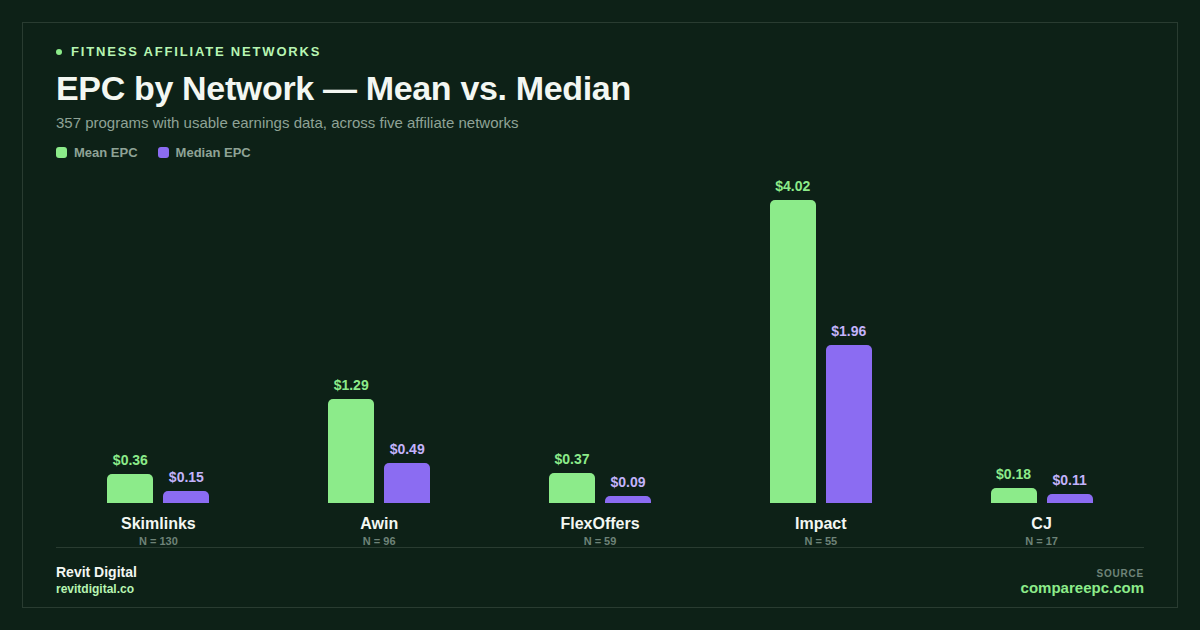
The first decision a fitness brand makes when it commits to affiliate is also the one least often shown real data: which network to join. Across 168 fitness programs in the CompareEPC dataset behind our fitness affiliate program benchmarks, publishers on Impact averaged $4.02 in earnings per click. On Awin, the average was $1.29. On CJ, $0.18. The field a fitness DTC brand actually chooses between at signup spans a 22x gap from top to bottom.
Source: CompareEPC fitness vertical dataset.
That spread gets cited in network roundups constantly. What almost never follows is the unpacking, because the honest version is less comfortable than a leaderboard. Part of the gap is the platforms themselves: the tools, the terms, the publisher pools. Part of it is which kinds of fitness brands end up on each network in the first place, how hard those programs get worked after launch, and even what each network charges for admission. A brand that signs somewhere because of a top-line average without understanding the split is betting on a number that wasn’t measuring what it thought.
This piece works through the three networks a fitness brand is realistically choosing between: what the data says, what each costs to join and run, and where the partner talent has concentrated. It’s explicit about where the data runs out. It also fixes a framing error that shows up in nearly every network comparison, including most of the ones ranking above this article: Skimlinks and the other aggregators are not a fourth option on this list. It closes with a decision framework matched to brand type, and with the option most brands forget exists, which is switching.
- 01The Three Networks Actually in Play
- 02Where the EPC Gap Actually Comes From
- 03What Each Network Actually Costs
- 04Impact for Fitness Brands
- 05Awin for Fitness Brands
- 06CJ for Fitness Brands
- 07Where Skimlinks and the Aggregator Layer Fit
- 08Matching the Network to the Brand
- 09Switching Networks Without Losing the Program
The Three Networks Actually in Play
At signup, the realistic direct-network shortlist for a fitness DTC brand is three names: Impact, Awin, and CJ. Other networks exist and plenty of brands land happily on them, but these three are where the scale and the fitness-specific density sit in this dataset, and they’re the comparison most brands actually run.
One line each, from reputation rather than data. Impact has the strongest reputation for API-driven, tech-forward partner management, and it’s where larger, venture-stage DTC brands tend to land. Awin carries the deepest reputation for European and international publisher reach, with a base that skews toward coupon, loyalty, and content publishers. CJ is the legacy enterprise network, the oldest of the three, with the thinnest fitness-specific footprint in this dataset.
Those are positioning sketches, drawn from general market reputation rather than anything citable, and they’re here to orient rather than to carry the argument. The load-bearing claims in this piece are the data ones. Check each network’s current positioning and pricing against its own materials before signing anything; reputation ages faster than infrastructure.
Where the EPC Gap Actually Comes From
| Network | Fitness Programs (n) | Avg. EPC |
|---|---|---|
| Impact | 55 | $4.02 |
| Awin | 96 | $1.29 |
| CJ | 17 | $0.18 |
Per-network performance across the fitness subset of the CompareEPC benchmark set. Sample sizes vary widely by network; the CJ figure rests on 17 programs and should be read as directional. Full methodology in the benchmarks report.
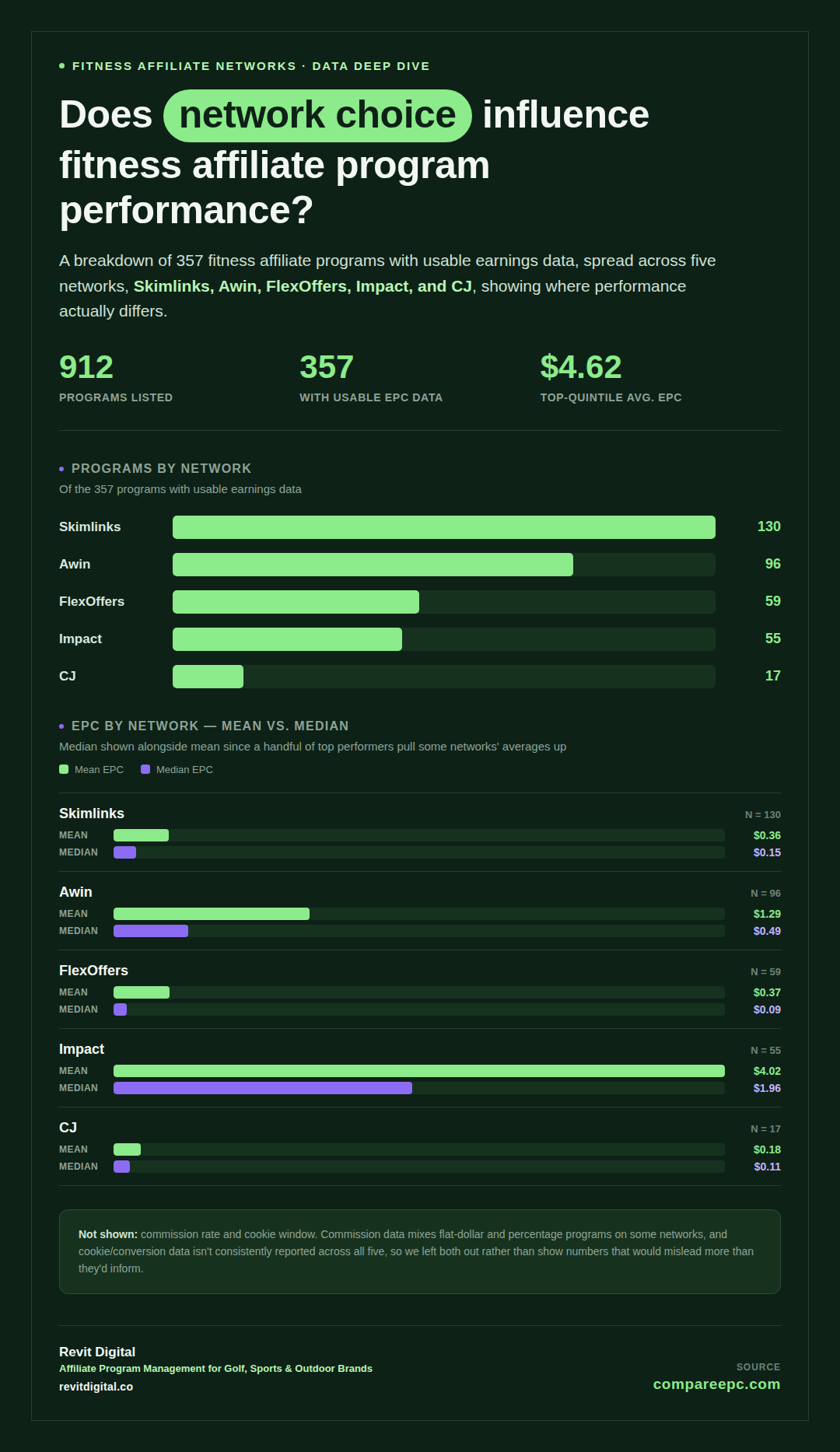
This table gets quoted more often than it gets read, so start with the sample sizes, because they carry most of the honesty in it. Impact’s $4.02 average rests on 55 fitness programs. Awin’s $1.29 rests on 96, the largest sample of the three and the most stable read. CJ’s $0.18 rests on 17. Seventeen programs is not a foundation for a verdict; it’s a foundation for a question. A handful of dormant listings or heavy-discount programs inside that 17 could account for most of the distance between CJ and the field. The CJ number appears three times in this piece and the caveat travels with it every time, and it should travel with it everywhere else too.
Second, averages blend very different kinds of programs. EPC is not a property of a network; it’s the output of four inputs a brand controls: site conversion rate, average order value, the commission rate, and the cookie window. The fitness brands clustered on Impact in this dataset skew toward connected fitness and larger-ticket equipment, with subscription and app-driven businesses in the mix. High AOV alone does a lot of work on an EPC line. Some portion of Impact’s average is a portrait of its tenants, not its plumbing.
Third, management intensity isn’t evenly distributed either. The brands that end up on Impact skew larger and better resourced, and actively managed programs outperform dormant ones on every network. Roughly a third of fitness programs across the vertical are live and producing nothing, and every one of those dormant listings drags its network’s average down a little. Network averages are blends of worked and unworked programs, and the blend differs by network for reasons that have nothing to do with platform quality.
Fourth, the price of admission differs across the three, and admission shapes composition: the networks charge in structurally different ways, and their economics filter who ends up on each roster to be averaged. The full fee picture gets its own section below.
So what is the signal actually worth, given all that? More than nothing, and in a specific way. The network a brand joins determines which publisher pool it recruits from, what it sits next to in the marketplace, and which tools its team gets. Publishers browsing a network’s marketplace see the neighbors, and the neighbors on Impact in this dataset are the highest-earning fitness programs tracked; its network-wide fitness average sits within reach of the vertical’s top-quintile benchmark of $4.62. Ecosystem placement is a real effect even where platform causation is murky, and a new program inherits its ecosystem the day it goes live.
The gravity runs on the recruiting side too, and in the brand’s favor more often than not. Professional affiliates go where the money is: they monitor the marketplaces where the strongest programs sit, and they apply to new listings in the neighborhoods they already work. Joining the network where the best programs live means recruiting from a pool that has already been sorted for seriousness. It also means competing against those same programs for partner attention, which is survivable only if the program’s own conversion rate, AOV, commission, and cookie window hold up. Where the top programs cluster, recruiting is easier and the bar is higher at the same time.
The gap is not purely a platform effect, but it isn’t therefore meaningless. It’s a map of where the fitness money currently sits, and where the partners chasing it are looking.
On the EPC Gap Between NetworksWhat Each Network Actually Costs
Network pricing is where public information is thinnest and marketing spin is thickest, so the ground rules come first. The table below reflects the best public views of each network’s advertiser-side pricing as of early 2026. Several cells are approximations, the quote-based ones most of all, and the figures may not represent the actual prices brands are paying; enterprise terms especially are negotiated case by case. Treat it as a map of the published landscape rather than a rate card. Verify the cells that matter against each network’s own pages before deciding, and weight the structure of each network’s costs more heavily than any single number in it.
| CJ Affiliate | Awin | Impact.com | |
|---|---|---|---|
| Entry price | Quote-only, no public tiers | Access: $49/mo; Accelerate: $99/mo; Advanced: custom | Starter: $30/mo; Essential: ~$500/mo; Pro: ~$2,500/mo; Enterprise: custom (~$50K+/yr) |
| Setup/access fee | One-time onboarding fee plus refundable deposit | $1 signup, refunded after first transaction | Unpublished one-time setup fee, scales with onboarding complexity |
| Take rate | ~20–30% on top of what you pay affiliates | 3.5% tracking fee on Access; 2.5% on Accelerate/Advanced | 2.5% network fee on all tiers |
| Contract | Custom, sales-negotiated | Access has a 3-month minimum; 14-day cancellation notice | Starter self-serve; Essential/Pro/Enterprise require a sales call |
Best public views of advertiser-side pricing as of early 2026. Quote-based and approximate cells may not represent the actual prices brands are paying. Confirm current terms on each network’s own advertiser pages.
Read the table by column shape rather than cell by cell. Awin’s column is flat and published: a dollar to sign up, $49 or $99 a month depending on tier, a take rate of 2.5 to 3.5 percent on transactions, a three-month minimum on the entry tier. Impact’s column starts cheaper at the self-serve bottom and climbs steeply: $30 a month for Starter, then roughly $500 for Essential and $2,500 for Pro, with custom enterprise deals that the public view puts near $50K a year and up, plus an unpublished setup fee that scales with onboarding complexity. CJ’s column is the absence of published structure: quote-only entry, a one-time onboarding fee plus a refundable deposit, terms negotiated deal by deal.
The most consequential cell in the table is the take rate, because it compounds against every commission payment the program ever makes. Impact charges a 2.5% network fee on all tiers, Awin 2.5 to 3.5% depending on tier, and the public view of CJ puts it near 20 to 30% on top of what the brand pays affiliates. That CJ figure is also the least verifiable in the table, since CJ publishes nothing and the number circulates through third-party sources, which is precisely what the caveat above exists for. But run the math at even the favorable end: a brand paying 10% commission owes roughly 10.25 cents of network cost on Impact’s dollar, about 10.35 on Awin’s Access tier, and somewhere near 12.5 to 13 cents on CJ if the public figure approximates reality. The spread doesn’t change what the partner receives. It changes what every sale costs the brand, permanently, on every order.
The cost shapes also explain the roster sizes in the EPC table above better than any quality argument does. Awin’s near-trivial fixed cost is why its fitness sample is the largest of the three: the network hosts everything from polished programs to abandoned listings, and both ends of that range sit inside its $1.29 average. Impact’s curve prices out dabblers by the Pro tier, concentrating its sample in programs with real budgets behind them. CJ’s quote-only door means every fitness program on it cleared a sales conversation first, a filter that selects for enterprises and for brands with unusual conviction. Who each network’s economics admit is half of who gets averaged.
Impact for Fitness Brands
The fitness programs on Impact in the benchmark set look like a particular kind of brand: connected fitness equipment, larger-ticket hardware, recovery devices, and subscription or app-driven businesses. Tonal, Therabody, and Future, spanning connected fitness hardware, recovery, and subscription training, are the names the set surfaces, and the pattern around them holds. The programs behind the network’s headline EPC are the ones where a single conversion is worth a lot and the product lends itself to sustained creator content.
That composition explains most of the number. A program selling a four-figure connected fitness machine doesn’t need an exotic commission rate to generate strong per-click earnings; AOV does the lifting. Subscription brands add a second layer, since recurring revenue supports commission structures one-time-purchase brands can’t match. A brand with this profile, or realistically aspiring to it, is shopping in Impact’s home territory.
The recruiting-gravity effect is at full strength here. The partners servicing the highest-earning fitness programs tracked in this dataset are, in large part, working inside Impact’s marketplace, because that’s where their existing programs live and where new ones appear. For a brand with the AOV and the team to compete in that neighborhood, the network with the best-performing programs is also the network with the densest bench of serious, professional partners to recruit from. The flip side is the same sentence read backwards: those partners’ standards were set by the best programs in the vertical, and a new listing has to clear that bar to get their attention.
On tooling, the reputation is API-first: deeper reporting, programmatic partner management, and integrations suited to teams running affiliate like a performance channel rather than a directory listing. That’s a reputation claim, not a data claim, and the current feature set should be checked against Impact’s own documentation before it drives a decision. What the data says is simpler: in this dataset, the highest-earning fitness programs chose Impact.
On money: the published view puts Starter at $30 a month self-serve, but the tiers matching serious fitness programs are Essential and Pro, roughly $500 and $2,500 a month, both behind a sales call, plus the unpublished setup fee and the 2.5% network fee that applies on every tier. Starter functions as a test bench. A brand running affiliate as a real channel lands higher up the curve, and should model its all-in cost at the expected tier, take rate included, against whatever the other networks quote.
Awin for Fitness Brands
Awin carries the largest fitness sample in the dataset, 96 programs, and a mid-pack $1.29 average: roughly a third of Impact’s figure, well ahead of CJ’s, and still a long way from the top-quintile earnings the vertical’s best programs reach. Read as an ecosystem, it’s a large, active, moderately earning fitness scene rather than a trophy case.
The publisher base is where Awin’s reputation does the most work: deeper European and international reach than its US-first rivals, and a mix that reportedly skews toward coupon, loyalty, and content publishers relative to Impact’s roster. If that reputation reflects the current base, the trade for a fitness brand is volume against per-click quality. Coupon and loyalty traffic arrives late in the buying journey and converts reliably, but it’s paid for demand capture rather than demand creation, which compresses the EPC line. Content and international publishers broaden reach instead, particularly for brands selling outside the US. Confirm the composition against Awin’s own publisher data before weighting this heavily; network demographics shift.
The recruiting trade runs through the same pipe. The partners easiest to recruit on Awin are the volume operators, the loyalty, coupon, and content publishers who monetize demand capture reliably, and there are a lot of them. The partners hardest to recruit there are the ones whose expectations were formed by the top programs on the other network. Easier recruiting, lower average earning power per partner recruited. Neither is better in the abstract; it depends what the program needs its first ten partners to do.
On cost: Awin’s published economics carry the lightest fixed commitment of the three, a $1 signup refunded after the first transaction, then $49 a month on Access or $99 on Accelerate, with a 2.5 to 3.5% take rate and a three-month minimum on the entry tier. That light touch is the price structure behind the 96-program sample above, and it’s also why that average carries so wide a range of program quality: almost nothing filters the roster. Confirm current tiers, fees, and contract terms on Awin’s advertiser pages before counting on the specifics; this is exactly the kind of detail that changes without announcement.
CJ for Fitness Brands
CJ’s fitness presence in this dataset is 17 programs averaging $0.18 EPC. Both halves of that sentence matter, and the second half deflates the first: with a 17-program sample, the average is directional at best, and no conclusion about the platform’s ceiling for fitness should be drawn from it. What can be said plainly is what the data shows. The fitness brands in this set mostly didn’t choose CJ, and the small group that did isn’t producing earnings comparable to the other two networks.
Two explanations fit, and the dataset can’t separate them. The first is a platform gap: CJ’s enterprise legacy means its recent energy skews toward very large retailers, and fitness DTC brands in the $2M to $20M range may simply not be surfacing there. The second is under-recruitment: 17 programs is thin enough that the average is hostage to a few listings, and a thin roster on any network is partly a dormancy story. Programs that stop being worked sink the averages of the networks they sit on, and quiet listings look identical to bad ones from the outside, a pattern we documented in our piece on fitness affiliate program red flags. A spot-check of CJ’s actual fitness advertiser directory, counting active brands with live creative and recent sales, is the only way to know which explanation holds, and it’s worth doing before anyone uses this table to rule CJ out.
There’s a third lens on the thin sample, and it’s structural: pricing. CJ is the only network of the three with no published door at all. Entry is quote-only, with a one-time onboarding fee plus a refundable deposit and terms negotiated case by case. On top of that sits the take rate, which public sources place near 20 to 30% of what the brand pays affiliates. That figure is the least verifiable number in this piece’s pricing table, but if it’s even directionally accurate, it’s a filter that prices out thin-margin DTC brands before a sales conversation ever starts. Under that view, part of the thin fitness roster is self-selection rather than neglect, which favors the under-recruitment explanation over the platform-gap one. And if the roster genuinely is thin, the cycle compounds: fewer strong programs means fewer top partners browsing the fitness directory, which makes recruiting harder, which keeps performance thin. Get the real numbers in a CJ sales conversation, including the take rate in writing, and model them all-in against Impact’s and Awin’s published tiers before deciding.
For a brand with an existing enterprise relationship on CJ, the calculus is different from a brand choosing fresh: the switching costs are already paid and procurement is already navigated. In that case, audit the fitness directory firsthand rather than trusting either this dataset’s small sample or CJ’s own pitch.
Where Skimlinks and the Aggregator Layer Actually Fit
Most network comparisons, including the earlier working draft of this one, put Skimlinks in the table next to Impact and Awin as if it were a competing signup option. It isn’t, and the distinction reshapes the whole decision. Skimlinks doesn’t run a program for a brand to join. It plugs into the program a brand already has: approving Skimbit Ltd, the entity behind it, inside an Impact, Awin, or CJ dashboard lets it generate affiliate links across the thousands of content sites it works with, all routing back through the brand’s existing network dashboard as ordinary partner traffic. A brand cannot sign up to Skimlinks instead of a network. It can only open its existing network program to Skimlinks as a publisher.
FlexOffers is the exception worth naming, because it genuinely sits on both sides of the line. It runs its own direct merchant program that a brand can join, and it also operates as a subaffiliate layer plugged into other networks’ programs. Which role it plays depends on the relationship a brand sets up, and it should be evaluated separately in each.
Whether to open the door to Skimlinks and its peers once inside a network is a real decision with quantified consequences, but it isn’t this article’s argument to make. The full mechanics and the EPC trade-off are covered in our guide to how to start an affiliate program for a fitness brand, in the section on keeping recruitment in your own hands. The short version for network shoppers: this decision happens after joining, inside the dashboard, and it shouldn’t influence which network gets chosen.
Matching the Network to the Brand
The data narrows the field; it can’t make the pick, because two brands with identical metrics can rationally choose differently. Six factors do most of the deciding.
AOV tier. The brands clustering on Impact in this dataset sell higher-ticket equipment and subscriptions, and their EPC advantage is substantially an AOV story. A brand selling a $1,800 rower or a $40-per-month training app is shopping in the same aisle as the programs generating Impact’s average. A brand whose hero product is a $30 accessory is not, and should weight the decision toward the network whose publisher base actually monetizes low-AOV carts.
Integration appetite. Impact’s tooling depth is only an advantage to a team that will use it. A two-person marketing team that wants affiliate running alongside everything else may get more out of a lighter-touch dashboard it actually checks weekly than an API it never touches. Capacity honestly assessed beats capability on paper.
Market geography. If the brand ships and sells internationally, Awin’s publisher reach stops being a nice-to-have; a deep European publisher base is the difference between a program that works in one market and one that works across several. US-only brands can weight this factor near zero.
Team familiarity. The most underrated factor in the set: whoever has run a network before runs the next program better on the platform they already know. Prior Impact or Awin experience from a previous role is a real asset, sometimes worth more than a fraction of a point of average EPC.
Recruiting pool. Good partners gravitate to good programs, which means partner talent concentrates on the network where the strongest programs sit. In this dataset that’s Impact, with the catch that its top programs set the bar a new listing competes against. Awin offers the easier recruiting floor at lower average partner earning power. The right match depends on an honest read of whether the program, on day one, is more likely to clear a high bar or win a broad one.
Cost shape. The three networks bill in structurally different ways, and the differences are large enough to filter the decision on their own. Awin’s published tiers keep fixed costs near-trivial, which prices in a cheap test of the channel. Impact’s do too at the self-serve bottom but climb steeply through the tiers growth programs actually land on. CJ quotes everything and, on the public take-rate view, charges several times more per sale to run. A brand that wants the channel proven before it commits real budget is priced into Awin’s model; a brand ready to run affiliate as a staffed performance channel absorbs Impact’s curve in exchange for the ecosystem above it.
For most fitness DTC brands in this dataset, the data favors Impact and Awin, and part of that favor is recruiting density as much as raw earnings. Impact where the brand’s AOV and the team’s appetite for a hands-on performance channel both point that way. Awin where volume, international reach, or a lower-friction start matter more. CJ is worth a serious look mainly for brands already inside an enterprise relationship there, and even then with the fitness directory audited firsthand rather than taken on faith from either a 17-program sample or a sales deck.
Switching Networks Without Losing the Program You’ve Built
One option most brands forget: the choice is reversible. A brand that realizes six months in that it joined the wrong network is not starting over. Partner relationships are portable; a program worth earning from is worth following, and most partners who are making money will re-apply when the brand asks, especially when the move comes with better terms or better tooling. What doesn’t move is the historical reporting, and what takes real work is replacing tracking links and updating live placements, which is mechanical rather than strategic.
The full sequence, and what it costs, is documented in our affiliate program migration case study. The one-line version: if the network is wrong, fix it sooner. The partner roster is the asset, and the asset moves.
Choosing a network, or undoing the choice
Network selection is the first compounding decision an affiliate program makes, and it deserves better than a roundup table. Revit Digital runs the selection analysis with a brand’s own AOV, margins, and the real fee structures in the model, and where a program is already sitting on the wrong network, we run the migration without losing the roster. Tell us where the program stands and we’ll tell you what the data says.

Reid Colson
Author
Leave a Reply